Bedding
Allergy-Proof Bedding: What Actually Works and What Wastes Money
Encasements, 130°F weekly washes, and humidity under 50% are the three levers that reduce dust mite allergen — the rest is mostly marketing.
By Ruth Alder · ·
Most of what is sold as allergy bedding treats a symptom that is not the problem. Dust mite allergen comes from mites living inside your mattress and pillows, feeding on skin cells in the warm, humid microclimate a bed provides. Sheets sit on top of that reservoir and touch none of it. The interventions that measurably reduce exposure are unglamorous: zippered encasements, weekly washes at a specific temperature, and a humidity number for the whole room. Everything else is decoration on top of those three.
Encasements are the single highest-leverage move
Zippered allergen-barrier encasements seal the mattress, box spring, and every pillow on all six sides. Mites inside lose their food supply over time; mite waste already inside can no longer reach you. Clinical trials of mite-impermeable bedcovers in sensitized children showed meaningful reductions in asthma symptoms — this is the one bedding intervention with trial evidence behind it, and it works while you sleep, without any maintenance beyond occasionally wiping it down.
The specification that matters is pore size, measured in microns. Mite allergen particles are blocked at pore sizes of 10 microns or below, but the tighter standard is 6 microns: it adds margin for cat allergen, which is smaller, and for the pore widening that comes with repeated washing. Look for encasements certified by the Asthma and Allergy Foundation of America (AAFA), which are tested against a published barrier standard rather than a marketing label. A zipper with a fabric flap behind it matters too — the zipper line is the weak point of a cheap cover.
Sheets labeled “hypoallergenic” are a different product doing a different job. A tightly woven sheet blocks particles migrating up from below, which is useful, but the word itself is unregulated — any brand can print it. Judge the weave and the certification, not the adjective.
On the top layer, weave density beats fiber marketing. Tightly woven percale and sateen cottons both pass allergen particles far less readily than a loose knit, and silk and Tencel offer tight weaves with less heat retention for hot sleepers. Polyester microfiber does form a dense barrier, but it traps the warm, humid microclimate against your body — exactly the conditions the rest of this routine is trying to remove. Choose the tightest weave you will actually sleep comfortably in, because a barrier that makes you sweat leads to piled-up blankets, and piled-up blankets are one more soft surface the routine now has to keep clean.
The wash that actually kills mites
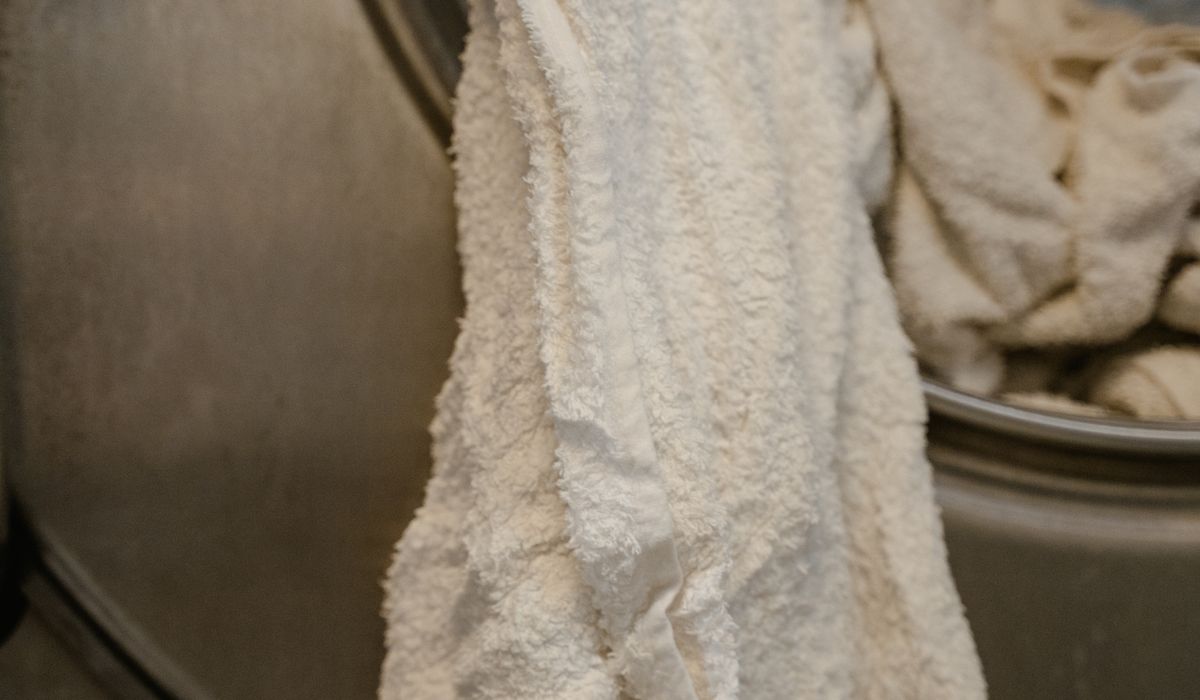
Weekly hot washing is the mechanical core of allergy bedding care.
Wash sheets, pillowcases, duvet covers, and washable blankets weekly at 130°F (54°C) or above, then run a hot dryer cycle. This is the recommendation of the American Academy of Allergy, Asthma and Immunology, and the temperature is the point: cool and lukewarm washes rinse out some allergen but leave the mites alive, so the colony regroups within days. The full washing mechanics — loads, detergents, what goes where — follow the same logic as our bedding washing guide.
Two extras extend the routine to the things that cannot survive a hot wash. Stuffed animals and decorative pillows go into the freezer for 24 hours, which kills mites but not the allergen they have already produced — so shake or vacuum them outdoors afterward. And a 15-minute high-heat dryer cycle on top of any wash closes the gap for anything that survived the water.
Humidity is the lever nobody buys
Dust mites do not drink; they absorb moisture from the air. That makes room humidity the master variable. Populations thrive when relative humidity runs above 50 percent and decline steadily below it. A $10 hygrometer tells you where your bedroom actually sits, and a dehumidifier — or simply running air conditioning in humid months — does the rest. In dry climates this lever is already handled; in humid ones it outperforms any spray or purifier on the market.
One free habit helps the same mechanism: pull the covers back for 20 to 30 minutes after waking instead of making the bed immediately. Body moisture trapped in the sheets is exactly the damp microclimate mites need, and letting it evaporate dries out their habitat daily.
What to skip
Several categories survive on the label rather than the evidence. Anti-mite laundry additives and sprays offer temporary, partial allergen breakdown and never reach mites deep inside a mattress — and you inhale whatever they leave behind. Standalone UV wands and ionizing purifiers marketed at mites have weak real-world results, because the allergen sits in fabric, not in open air. An air purifier with a HEPA filter has a role for airborne allergens like pollen and pet dander, but it is a supplement to the bed routine, not a substitute. And replacing a mattress to escape mites is the weakest move of all: without encasements, a new mattress recolonizes from the rest of the room within months.
A realistic weekly system
The routine that follows from the evidence is short. Encase the mattress, box spring, and pillows once — that is a one-time purchase. Wash everything washable weekly at 130°F and dry hot. Keep the bedroom below 50 percent relative humidity and check the hygrometer occasionally. Vacuum the mattress surface every week or two with a HEPA-filter vacuum when changing sheets. Replace pillows on their normal schedule — see how often to replace pillows for the timelines — since an encased pillow’s job is to hold out mites, not to stay fresh forever.
None of it requires special products beyond the encasements themselves. The bedding care routines that reduce allergen are the same ones that keep bedding clean generally — they just run at a specific temperature, on a strict weekly clock, with the humidity number watched alongside.
Layer recap
Specs first, owners second. Check the layer you are about to buy against the layers above and below it — most bad reviews are mismatches, not bad products.
- Foundation
- Slat spacing and center support decide whether the mattress above keeps its shape. Read the foundation guide
- Support
- Firmness is a 1–10 scale, not a feeling — read it by weight and sleep position. Read the support guide
- Comfort
- A topper fixes one specific problem. Anything over 2 in only changes surface feel. Read the comfort guide
- Warmth
- Fill power means nothing without fill weight beside it. Read the warmth guide
- Surface
- Weave, staple length and GSM — then read the wash count, not the thread count. Read the surface guide
- Finish
- Loft has to match sleep position, and it has to come back overnight. Read the finish guide
Bed Layers, Decoded puts all six layers on one page — the numbers worth checking, the marketing traps, and how to read owner feedback before you order.
FAQ
Do hypoallergenic sheets stop dust mite allergies? +
Not on their own. Dust mites live inside the mattress and pillows, where no sheet reaches, so sheets are the last line of defense rather than the main one. The intervention with the strongest evidence is zippered encasements on the mattress and pillows, combined with weekly hot-water washing of everything that is washed.
What temperature kills dust mites in the wash? +
130°F (54°C) or hotter, weekly, followed by a hot dryer cycle. Cold and lukewarm washes remove some allergen but leave mites alive, which is why the standard advice from allergy organizations specifies the temperature rather than just the frequency. Items that cannot tolerate hot water still benefit from hot drying.
How long does it take for allergy bedding to make a difference? +
Expect weeks, not days. Encasements cut off new colonization immediately, but allergen already sealed inside a mattress degrades slowly, and it takes sustained humidity control and repeated hot washes to bring the room's allergen load down. Most people notice the clearest change after the first few weeks of consistent washing and drying.