Everyday Essentials
Bath Mat Buying Guide: Material, Grip and Size That Matter
Cotton terry, memory foam, teak and waffle mats compared by dry time, grip and lifespan — plus the two-mat rotation that keeps the floor clean.
By Ruth Alder · ·
A bath mat has two jobs, and almost every bad mat fails the second one. It absorbs the water your feet carry out of the shower, and then it dries — before the next shower, before the mold has a chance. The first job is easy; any thick cotton will do it. The second job is where materials, backing, and rotation decide whether a mat lasts two years or turns sour in two months. This guide sorts the common types by how they handle both, because a mat you cannot wash on a schedule is the wrong mat no matter how it feels on day one.
The material line-up
Cotton terry is the default for good reason. The same loop structure that makes terry towels absorbent works on the floor, cotton tolerates hot washes endlessly, and worn mats cost little to replace. The trade-off is bulk: thick terry holds a lot of water and dries slowly, so it wants a fan or a sunny spot. Dense terry mats are also heavy — a plus for staying flat, a minus for laundry day. The GSM logic from our bath towel buying guide applies directly: denser cotton absorbs more and dries slower, on the same curve.
Waffle and flat-weave cotton flips that trade. The low, open weave absorbs less per step but sheds moisture fast, so it is dry again hours before a thick terry mat would be. It is the right pick for bathrooms that run damp or mats that get two showers a day. Underfoot it feels thin, which some households never forgive and others prefer — a flat mat does not curl at the edges the way soft terry eventually does.
Memory foam is a comfort product wearing a utility label. The plush core feels luxurious on a cold morning and wicks water off soles quickly, but the whole slab dries slowly and the microfiber surface is more fragile in the wash than any cotton. It suits a low-traffic bathroom with good ventilation and a household that values the feel; it does not suit shared or windowless bathrooms.
Teak or bamboo slat mats skip the absorbency job entirely and lean on drainage. Water falls between slats and the wood dries fast, so nothing is ever soaked — the cleanest solution to the damp-mat problem, provided you accept a hard, grooved surface underfoot and occasional oiling. They pair well with a small cotton mat for the spot right at the shower lip.
| Material | Absorbency | Dry speed | Care | Best for |
|---|---|---|---|---|
| Cotton terry | High | Slow | Hot machine wash | Default family bathroom |
| Waffle cotton | Moderate | Fast | Hot machine wash | Damp rooms, heavy use |
| Memory foam | High | Slowest | Gentle wash, air dry | Low-traffic, comfort-first |
| Teak slats | None | Fastest | Wipe and oil | Shower lip, spa feel |
Grip: the part that prevents injuries
Wet tile plus a sliding mat is the actual hazard in a bathroom, so backing outranks softness in the safety ranking. Look for a full-coverage rubber or latex backing rather than corner dots, and treat the backing as the consumable part: it degrades with heat, so cold-wash and line-dry any backed mat if you want the grip to last. The alternative is a non-slip liner pad under an unbacked mat — this is the durable setup, because the cotton gets washed hot without ceremony and the liner is replaced for a few dollars when it wears. Whatever the system, press the mat down with a wet foot once and check for slide before trusting it.
Size and placement
Measure the floor strip you actually stand on, then buy to cover it with a margin. The standard 20 by 30 inch mat covers the common single-vanity zone; 17 by 24 inches fits beside a toilet or a pedestal sink; 24 by 36 inch runners suit double vanities. Two placement rules prevent most damp-mat problems: keep the mat out of the toilet’s splash zone, and leave a gap between the mat edge and the vanity or tub, because fabric pressed against a fixture wicks water into a permanently damp seam. If the shower door drips onto the floor, the mat goes where the drip lands, not where the catalog photo put it.
The rotation that keeps mats clean
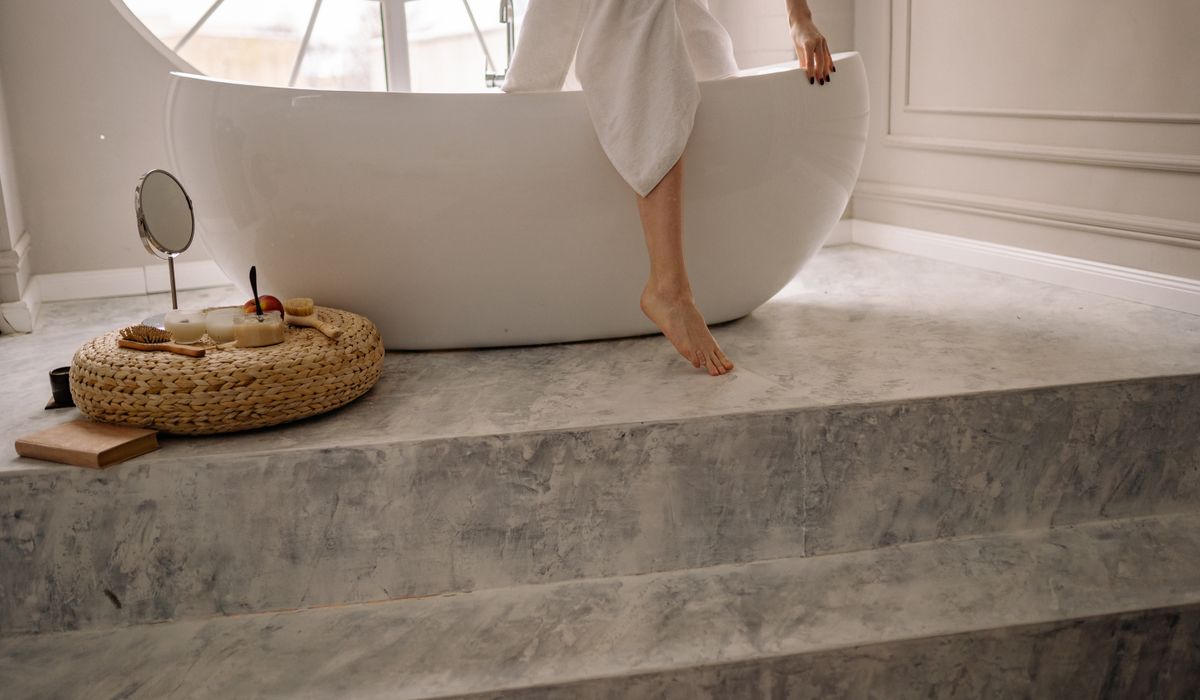
The moment after stepping out is when a mat does its real work — and gets soaked.
One mat used daily never fully dries, and a chronically damp mat is where smell and mildew start. The fix is the same rotation logic that runs a working kitchen — our kitchen towel guide covers the same principle in a different room. Keep two mats per bathroom: one down, one drying, swapped at every wash. Hang the wet one over the tub edge or a rack after each shower instead of leaving it flat, and it re-enters rotation in hours rather than days.
Washing rules by type: cotton mats take warm water, regular detergent, and no fabric softener — the same coating rule that governs all cotton absorbency. Backed mats get cold washes and air drying to spare the rubber. Memory foam follows its label, usually a gentle cycle and flat drying. Shake mats out before washing; hair and grit caught in the pile shorten every machine’s patience.
What a good setup costs
Cotton terry and waffle mats are inexpensive enough that the two-mat rotation is cheap to run — a bathroom can be fully equipped for less than the cost of one designer mat. Memory foam and teak carry a real premium, and both are worth it only when their specific trade-offs fit the room: comfort-plus-ventilation for foam, drainage-plus-hard-surface for teak. If you are outfitting a bathroom from nothing, the mat is one line in a longer list — our first apartment essentials checklist shows where it sits in the full set.
The verdict, compressed: flat or medium cotton with a separate non-slip liner, two mats in rotation, washed on a fixed schedule. That setup outlives every fancier option on the shelf, and it is the cheapest to keep honest.
Layer recap
Specs first, owners second. Check the layer you are about to buy against the layers above and below it — most bad reviews are mismatches, not bad products.
- Foundation
- Slat spacing and center support decide whether the mattress above keeps its shape. Read the foundation guide
- Support
- Firmness is a 1–10 scale, not a feeling — read it by weight and sleep position. Read the support guide
- Comfort
- A topper fixes one specific problem. Anything over 2 in only changes surface feel. Read the comfort guide
- Warmth
- Fill power means nothing without fill weight beside it. Read the warmth guide
- Surface
- Weave, staple length and GSM — then read the wash count, not the thread count. Read the surface guide
- Finish
- Loft has to match sleep position, and it has to come back overnight. Read the finish guide
Bed Layers, Decoded puts all six layers on one page — the numbers worth checking, the marketing traps, and how to read owner feedback before you order.
FAQ
What size bath mat do I need? +
A single-sink vanity works with a 20 by 30 inch mat, the standard that covers the strip in front of sink and shower. A 17 by 24 inch mat suits a small bathroom or a toilet-side spot, and a 24 by 36 inch runner fits double vanities or wide shower doors. Measure the clear floor strip first — a mat that touches the toilet or vanity edge collects water in the gap and stays damp.
How often should you wash a bath mat? +
Every one to two weeks for a mat used daily, and immediately if it smells damp. Cotton mats go in warm water with regular detergent and no fabric softener, which coats fibers and kills absorbency. Mats with rubber or latex backing need gentler cycles and should never see high heat in the dryer, because the backing cracks and sheds onto the floor.
Are memory foam bath mats worth it? +
They are comfortable underfoot and dry the sole well, but they dry slowly as a whole and the soft pile traps water longer than flat cotton. In a bathroom with a strong fan and low traffic they work fine; in a busy shared bathroom they turn sour faster than cotton. A flat cotton mat with a good separate liner is the more durable default.